Gremban & Gremban Dental

Improving your smile

office
phone
  • 865 North Railroad Street
    Eagle River, WI 54521
  • (715) 479-6100

Our Blog

Thumb Sucking

October 18th, 2023

Learning to suck their thumbs is one of the first physical skills babies acquire. In fact, ultrasound images have revealed babies sucking their thumbs in the womb! Babies have a natural sucking reflex, and this activity is a normal way for your baby to soothe herself.

If your toddler still turns to her thumb for comfort, no need to worry. Most children give up this habit as they grow, and generally stop completely between the ages of two and four. But what of the child who doesn’t? Should you encourage your child to stop? And when?

When Thumb Sucking Becomes a Problem

After your child turns five, and certainly when her permanent teeth start to arrive, aggressive thumb sucking is something to watch for. This type of vigorous sucking, which puts pressure on the teeth and gums, can lead to a number of problems.

  • Open Bite

Our bites are considered normal when the upper teeth slightly overlap the lower where they touch in the front of the mouth. But with aggressive thumb sucking, teeth are pushed out of alignment. Sometimes this results in a condition called “open bite,” where the upper and lower teeth don’t make contact at all. An open bite almost always requires orthodontic treatment.

  • Jaw Problems

Your child’s palate and jaw are still growing. Aggressive thumb sucking can actually change the shape of the palate and jaw, and even affect facial structure. Again, orthodontic treatment can help, but prevention is always the better option!

  • Speech Difficulties

Prolonged thumb sucking has been suggested as a risk factor for speech disorders such as lisping, the inability to pronounce certain letters, or tongue thrusting.

The consequences from aggressive thumb sucking can be prevented with early intervention. What to do if you are worried?

Talk to Us

First, let us reassure you that most children stop thumb sucking on their own, and with no negative dental effects at all. But if your child is still aggressively sucking her thumb once her permanent teeth have started erupting, or if we see changes in her baby teeth, let’s talk about solutions during an appointment at our Eagle River office. We can offer suggestions to help your child break the habit at home. There are also dental appliances available that can discourage thumb sucking if your child finds it especially hard to stop.

Work with your Child

  • Be Positive

Positive reinforcement is always best. Praise her when she remembers not to suck her thumb. Make a chart with stickers to reward every thumb-free day. Pick out a favorite book to read or activity you can share.

  • Identify Triggers

Children associate thumb sucking with comfort and security.  If your child turns to her thumb when she’s anxious, try to discover what is bothering her and how to reassure her. If she automatically sucks her thumb when she is bored, find an activity that will engage her. If she’s hungry, offer a healthy snack.

  • Talk about It!

Depending on her age, it might help your child to understand why stopping this habit is important. We are happy to explain, in a positive, age-appropriate way, just how breaking the thumb sucking habit will help her teeth and her smile.

Again, most children leave thumb sucking behind naturally and easily. But if what is a comfort for your child has become a concern for you, please give us a call. Drs. Darrin and Greg Gremban will work with you and your child to prevent future orthodontic problems and begin her lifetime of beautiful smiles.


 

Is it possible to over brush?

October 18th, 2023

Our team at Gremban & Gremban Dental will tell you brushing on a regular basis is critical for a healthy mouth, but you can definitely overdo a good thing. Known as “toothbrush abrasion,” over brushing can lead to sensitive teeth and receding gums, not to mention the wearing down of the protective layers of your tooth enamel. Over brushing can also push back your gums, and in the process, expose the dentin layer under the enamel.

“So, how do I avoid over brushing?”

  • Use a soft or extra-soft bristled toothbrush to prevent gum damage and wear on the soft tooth dentin
  • Keep in mind which direction bristles face when you brush. They should be perpendicular, not parallel. Place the head of your toothbrush with the tips of the bristles at a 45-degree angle to the gum line and brush away!
  • Move the toothbrush with short strokes and a scrubbing motion, several times in each spot – don’t saw back and forth across the teeth with your toothbrush.
  • Apply just enough pressure to feel the bristles against the gums. If you are squashing the bristles, you're brushing too hard.
  • Replace your toothbrush when you notice frayed and bent bristles.
  • Brush for two minutes at a time

If you have any questions about proper brushing techniques, ask us about it at your next appointment or give us a call today!

What Are Chalky Teeth?

October 11th, 2023

You’ve always taken care of your child’s smile. You make sure thorough brushing and flossing take place twice a day. You serve foods high in vitamins and minerals and low in sugar. You make and keep regular dental appointments at our Eagle River office. But even with the best dental routines, sometimes conditions can occur that will require additional professional care.

One of these conditions can affect your child’s enamel while the tooth is still forming. When baby teeth or adult teeth appear, you might notice white, creamy yellow, or brown spots in otherwise healthy-looking enamel. These spots are softer and rougher than normal hard, smooth enamel. Because of their texture and color, such teeth are often referred to as “chalky teeth,” but this condition is actually known as enamel hypomineralization.

What is hypomineralization?

Enamel is the strongest substance in our bodies—stronger even than bones. Enamel is largely composed of minerals. If something disrupts the process of enamel development in baby or adult teeth, the result can be abnormally low mineral content in the enamel. This leaves teeth weaker and more likely to suffer decay and damage.

Premature birth, low birth weight, and other pre-natal factors have been suggested as risk factors for hypomineralization in primary teeth enamel. Permanent teeth can be vulnerable to this condition as well. Adult teeth are forming in young children well before they make an appearance. It’s been suggested that certain early childhood factors, such as recurring high fevers, some diseases, even specific antibiotics, can interrupt the formation of the enamel and lead to hypomineralization of adult teeth.

What are the results of enamel hypomineralization?

Children with this condition are much more likely to experience rapid tooth decay because of their weaker, more porous enamel, especially in the molars. Further, they tend not to respond as well to the numbing effects of local dental anesthetics, while their teeth tend to be more sensitive to pain. Cases can be mild, moderate, or severe. In severe cases, teeth might require crowns or possibly extractions, but even mild discoloration and other cosmetic problems can lead to self-consciousness in your child.

How can we help?

Catching this condition early is very important. If your child has had any medical conditions that might affect tooth development, let Drs. Darrin and Greg Gremban know even before that first tooth comes in. If you notice anything unusual about a new baby or adult tooth, give us a call. For primary or permanent teeth, the sooner we can begin treatment, the better the long-term outlook.

We might suggest fluoride applications or desensitizing treatments. We can apply sealants to reduce the risk of cavities, and use bonding to restore discolored or weak patches in the tooth. Both of these methods have greater success if the enamel near the affected area is in good condition, so early treatment is vital. If teeth require more protection, crowns are often the best choice. We will design a treatment program to suit your child’s individual needs now and for the future.

How can you help?

Dental hygiene is important for every child, but especially for a child with weak and porous enamel. Because children with hypomineralized enamel develop cavities more quickly that those with strong enamel, it is very important to watch your child’s diet and keep to a regular, careful, and thorough routine of brushing and flossing at home. Be attentive to any sensitivity problems, and be sure to follow any suggestions we might have for strengthening enamel.

Remember, early diagnosis and treatment is always best! If at any time you notice chalky patches, or have any other concerns about the appearance of your child’s teeth, if they seem to be causing your child pain or are unusually sensitive, call Drs. Darrin and Greg Gremban immediately. We want to work with you to treat any current problems and to prevent new ones.

Losing a Baby Tooth

October 11th, 2023

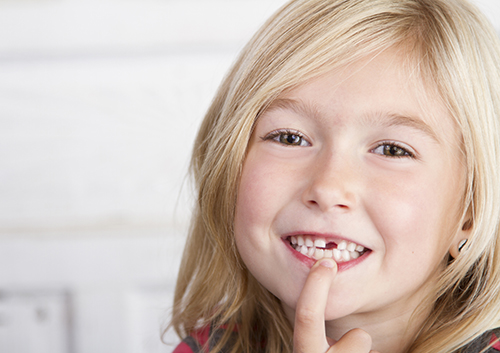
It seems like yesterday. There you were, comforting your baby through sleepless nights, soothing her with a dentist-approved teether, celebrating as that first tiny tooth poked through her gums. And now here she is running to show you that same tooth, wiggly, loose, and almost ready for the Tooth Fairy. Now what?

Be Prepared

Children normally lose that first tooth somewhere around the age of six, but a year or two earlier or later is not uncommon. If you ever took a business class, you might have heard of the inventory method called “First In, First Out.” Baby teeth operate much the same way! The two bottom front teeth, followed by the two upper front teeth, will probably be the first teeth your child loses. Once you notice some wiggling, let your child know what is going on and reassure her that it is a normal part of growing up.

What to Expect with that First Loose Tooth

Normally, baby teeth become loose when the pressure from the permanent tooth below gradually breaks down the roots of the primary tooth. If your child has a loose tooth, encourage him to wiggle, not pull. Typically, gentle wiggling is all that is needed to free a tooth that has lost most of its root and is ready to be replaced. Avoid pulling or forcing the tooth, because that can cause injury to the root area if the baby tooth isn’t ready to come out. Call our Eagle River office if you have any questions about loose teeth. Drs. Darrin and Greg Gremban and our team also have suggestions if the baby teeth don’t become loose on schedule, or if they stubbornly remain in place even after the adult teeth have started to show up. One important note—if your child ever loses a tooth through accident or injury, call us at once. We might need to provide a spacer to give your child’s permanent teeth the proper time and space to come in.

Celebrate this Milestone with Your Child

The arrival of the Tooth Fairy is a familiar way to mark the occasion, and she can leave your child a note, a small gift, even a brand new toothbrush. Or explore other options!

If your child is fascinated by stories and traditions, learn about El Ratón Pérez (Perez the Mouse), a familiar tooth-collector in many Spanish speaking countries, or his French cousin, La Petite Souris (the Little Mouse). In other parts of Europe, Asia and Africa, children throw teeth on the roof, drop them in a glass of water, or hide them in a slipper. This is a great opportunity for you and your child to explore the world!

If your child likes science, look into books that explain the biology of baby and adult teeth in an age-appropriate way. You could print a chart of the primary teeth and take notes on each lost tooth as it makes way for the permanent tooth below. Or track her progress with photos showing the baby tooth, the gap left by the tooth, and the adult tooth as it comes in.

Losing that first tooth is an important moment for your child—and for you. Be prepared to celebrate another milestone together, and always feel free to talk to Drs. Darrin and Greg Gremban if you have any questions about this new stage in your child’s life.

Back to top