Gremban & Gremban Dental

Improving your smile

office
phone
  • 865 North Railroad Street
    Eagle River, WI 54521
  • (715) 479-6100

Our Blog

Oral Cancer Facts and Figures

October 31st, 2019
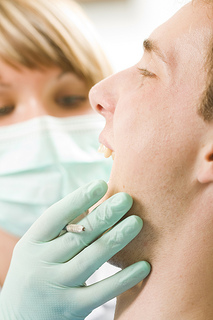
Oral cancer is largely viewed as a disease that affects those over the age of 40, but it can affect all ages, even non-tobacco and alcohol users. Oral cancer can occur on the lips, gums, tongue, inside lining of the cheeks, roof of the mouth, and the floor of the mouth. Our team at Gremban & Gremban Dental recently put together some facts and figures to illustrate the importance of visiting our Eagle River office.

Our friends at the American Cancer Society recommend an oral cancer screening exam every three years for people over the age of 20 and annually for those over age 40. Because early detection can improve the chance of successful treatment, be sure to ask Drs. Darrin and Greg Gremban and our team to conduct an oral exam during your next visit to our Eagle River office.

  • Symptoms of oral cancer may include a sore in the throat or mouth that bleeds easily and does not heal, a red or white patch that persists, a lump or thickening, ear pain, a neck mass, or coughing up blood. Difficulties in chewing, swallowing, or moving the tongue or jaws are often late symptoms.
  • The primary risk factors for oral cancer in American men and women are tobacco (including smokeless tobacco) and alcohol use. Risk rises dramatically (30%) for people who both smoke and consume alcohol regularly.
  • Oral cancers are part of a group of cancers commonly referred to as head and neck cancers, and of all head and neck cancers they comprise about 85% of that category.
  • Oral cancer is the sixth most common cancer among men.
  • Oral cancer is more likely to affect people over 40 years of age, though an increasing number of young people are developing the condition.
  • Death rates have been decreasing over the past three decades; from 2004 to 2008, rates decreased by 1.2% per year in men and by 2.2% per year in women, according to the American Cancer Society.
  • About 75% to 80% of people with oral cavity and pharynx cancer consume alcohol.
  • The risk of developing oral cavity and pharynx cancers increases both with the amount as well as the length of time tobacco and alcohol products are used.
  • For all stages combined, about 84% of people with oral cancer survive one year after diagnosis. The five- and ten-year relative survival rates are 61% and 50%, respectively.
  • It is estimated that approximately $3.2 billion is spent in the United States annually on treatment of head and neck cancers.

Cancer can affect any part of the oral cavity, including the lip, tongue, mouth, and throat. Through visual inspection, Drs. Darrin and Greg Gremban and our team at Gremban & Gremban Dental can often detect premalignant abnormalities and cancer at an early stage, when treatment is both less extensive and more successful.

Please let us now if you have any questions about your oral health either during your next scheduled appointment, by giving us a call or asking us on Facebook.


Radiation and the Safety of Dental X-Rays

October 24th, 2019

It is not uncommon to be concerned about your safety when you have dental X-rays performed. Putting on a heavy lead vest may make you apprehensive. The benefits of dental X-rays far outweigh the risks when safety procedures are followed and the number of X-rays is limited to the required number.

About Dental X-rays

Intraoral X-rays are the most common, and include bitewing X-rays. These allow Drs. Darrin and Greg Gremban and our team at Gremban & Gremban Dental to detect caries (cavities) and check the health of your bone and root structure. Extraoral X-rays provide the information we need to monitor your jaw and temporomandibular joint (TMJ), as well as look for impacted teeth and tooth development.

X-ray Safety

A set of four bitewing X-rays exposes you to about 0.005 mSv (millisievert) of radiation, which is equal to the amount of radiation you receive in an average day from natural sources. A panoramic X-ray exposes you to about twice the amount of a bitewing. In both cases the risk is negligible and worth the diagnostic benefits.

Guidelines from the American Dental Association are offered for individuals who are not at high risk for cavities. Children in this group should have X-rays every one or two years. Teenagers should have X-rays every one-and-a-half to three years. Adults can go two to three years between X-rays. If you are at higher risk, yearly X-rays are not harmful and can save your teeth.

No matter what type of X-ray you are having, it is extremely important to tell Drs. Darrin and Greg Gremban or one of our technicians if you are pregnant or may be pregnant. If you are concerned about the number of X-rays you are having done, or about any radiation you are exposed to, please give us a call at our convenient Eagle River office and talk to us about your concerns.

How Sedation Dentistry Can Help You Overcome Dental Anxiety

October 17th, 2019

Putting off your dental visit to Gremban & Gremban Dental because of fear or anxiety only increases the potential for tooth decay or gum problems. At our office, Drs. Darrin and Greg Gremban and our team offer solutions that allow you to relax, without any pain, so you can keep your mouth healthy. Our solutions can help with many different anxiety issues for both adults and children.

Help with minor anxiety

Nitrous oxide is an excellent choice for most patients. Sometimes referred to as laughing gas, nitrous oxide can be regulated to provide you with the amount of sedation you need. When used before a local anesthetic, the injection will not be uncomfortable and you should not notice any pain during your procedure.

If you plan to use nitrous oxide, you can drive yourself to your appointment. In most cases, you will be fine to drive after your treatment: the sedation wears off quickly. Nitrous oxide can also be used along with other sedation techniques to produce a higher level of sedation.

Oral sedatives are available in a liquid or pill form. If you experience moderate anxiety levels, you can be given a tablet to take before your appointment. This type of sedation will be beneficial in relieving the anxiety that can build before your procedure. However, if you choose this method, you cannot drive yourself to your appointment.

Help with major dental anxiety

If you experience extreme levels of stress and anxiety about dental treatment, you may wish to discuss deep sedation or general anesthesia. With these techniques, you will be barely conscious or unconscious during your procedure. You will not feel discomfort or pain. Once you have experienced dentistry with a sedation technique, your anxiety level may decrease on its own.

People are not born with the fear of a dental exam. Unfortunately, most anxiety issues are due to a bad dental experience or childhood trauma. Sometimes anxiety comes from listening to the tales of others, who may have exaggerated their story. Talk to Drs. Darrin and Greg Gremban and our team about your dental concerns or fears. Let us help you so you can get the dental care you need for a healthy mouth for life.

For more information about overcoming dental anxiety, or to schedule an appointment with Drs. Darrin and Greg Gremban, please give us a call at our convenient Eagle River office!

DIY Cures for Bad Breath

October 10th, 2019

Are you afraid to open your mouth because you have bad breath? You’re not alone bad breath or Halitosis happens to everyone, at one time or another. If you have chronic bad breath there could be a number of reasons, including:

  • Gum disease
  • Sinus problems
  • Bacterial infection in your mouth
  • Stress
  • Strong odor from something you ate
  • Dry mouth

The good news is, none of the causes of bad breath are serious, and they can all be treated. There is a long list of DIY home remedies that have proven effective. Before you try any of them you should be evaluated by Drs. Darrin and Greg Gremban to make sure you do not have a serious oral infection. Of course, you should also always practice good oral hygiene. If you go a week without brushing your teeth, your bad breath is going to be horrible!

1. Cinnamon Mouthwash

Cinnamon is known to help prevent bacteria in your mouth, and lemon has strong citrus properties that will eliminate your bad breath problem.

Preparation

  • Put a half teaspoon of cinnamon in a jar or bottle that has tight fitting lid.
  • Next add the juice from two lemons freshly squeezed lemons.
  • Combine all of the ingredients in a cup of lukewarm water and pour into your jar.
  • Shake the jar well and set it aside for two to three hours.
  • Before using the mouthwash always shake it well.
  • Gargle and swish one to two tablespoons of the mouthwash for about a minute

2. Tea

Black and green tea are beneficial in prevent bad breath. Black tea aids in controlling plaque and bacteria that can cause bad breath. Green tea contains antibacterial properties that fight off the natural occurring germs in your mouth, keeping your breath fresh. Both black and green tea contains polyphenol, a property that can prevent the formation of the foul odor caused by bacterial growth.

Preparation

  • Steep a black of green tea bag in one cup of hot water and drink one to two cups a day to keep your bad breath away.

3. Tea Tree Oil

Tea tree oil contains natural antiseptic and anti-fungal properties that help kill bacteria and fungi in your mouth, caused by particles of food left behind.

Preparation

  • You will need one teaspoon of tea tree oil, peppermint oil, and lemon oil.
  • Combine all three in eight ounces of lukewarm water and stir well. Use daily as a mouthwash to get rid of your bad breath.

Back to top