
Gremban & Gremban Dental

Improving your smile

office
phone
  • 865 North Railroad Street
    Eagle River, WI 54521
  • (715) 479-6100

Our Blog

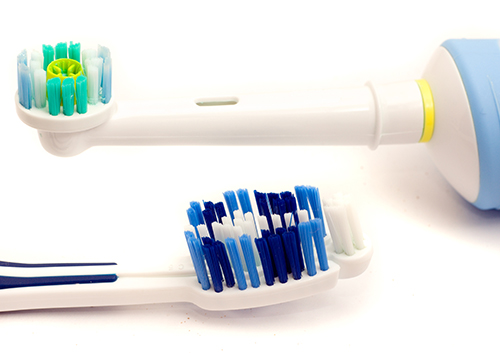
Electric or Manual Toothbrush: Why It Does (and Doesn't) Matter

February 26th, 2025

You live in the golden age of toothbrushes. Until a few decades people used twigs or brushes made from animal hair to clean their teeth: not very soft and none too effective.

Now, you have a choice of manual brushes with soft, medium, or hard bristles. Or you might choose to go with an electric toothbrush instead.

Have you ever wondered whether manual or electric brushes provide better cleaning? Actually, they both do the job. The key is to brush and floss every day, regardless of the kind of brush you prefer.

At our Eagle River office, we like to say the best brush is the one you'll use. So if you prefer manual, go for it. If you prefer electric, turn it on.

Both types have their advantages but both types will get the job done as far as removing plaque.

Electric Toothbrushes

  • Provide power rotation that helps loosen plaque
  • Are great for people with limited dexterity due to arthritis or other problems
  • Are popular with kids who think the electric brushes are more fun to use
  • Can come with variable speeds to help reduce pressure on sensitive teeth and gums

Manual Toothbrushes

  • Can help brushers feel they have more control over the brushing process
  • Allow brushers to respond to twinges and reduce the pressure applied to sensitive teeth and gums
  • Are more convenient for packing when traveling
  • Manual brushes are cheaper and easier to replace than the electric versions.

In many ways, the golden age is just beginning. There are already phone apps available to remind you to brush and floss. New apps can play two minutes worth of music while you brush, help you compare the brightness of your smile or help explain dental procedures. Maybe someday we’ll even have programs that examine your teeth after brushing and identify spots you might have missed.

Interproximal Cavities: The Inside Story

February 19th, 2025

Time to brush! So, you make sure you gently brush the plaque off the outside surfaces of your teeth. You want to present a gleaming smile to the world, after all. And you make sure to brush the inside surfaces as well, because who wants to feel a fuzzy patch of plaque every time their tongue hits their teeth? And, naturally, you remember to clean the tops of your molars, because those crevices make them more cavity-prone than any other surface.

Done? Not quite!

You might be surprised to learn that no matter how well you’ve brushed all the visible surfaces of your teeth, you’ve left quite a bit of enamel untouched—the adjoining, or touching, surfaces of the teeth which sit next to each other.

You’ve probably noticed that your bristles can’t . . . quite . . . reach all the enamel between your teeth (especially between your molars!) when you’re brushing. This means that food particles and plaque have an easier time sticking around. And when the bacteria in plaque are left undisturbed, especially with a banquet of food particles available, they produce acids which gradually eat away at the enamel covering our teeth, creating a cavity.

Here’s where we work in some specific dental vocabulary. “Interproximal” means between the adjoining, or touching, surfaces of the teeth. And an interproximal cavity is a cavity which develops on one of those side surfaces of your teeth.

  • Discovering Interproximal Cavities

Clearly, a cavity between the teeth won’t be as obvious as other cavities. How will you know if a dental appointment is in order?

There are typical symptoms which can show up when you have a cavity. Chewing might be painful. You might feel pain or sensitivity when you eat or drink something which is hot, or cold, or sweet. But pain and/or sensitivity aren’t always present, especially when a cavity is just beginning to develop.

Regular exams are important so you can catch small cavities before they become more serious. That’s why, at your regular dental exams, Drs. Darrin and Greg Gremban will always check for any signs of decay on every surface of each tooth, including those places which aren’t easily visible. And that’s why X-rays can be an important tool for locating these tricky cavities.

  • Treating Interproximal Cavities

If Drs. Darrin and Greg Gremban and our team finds a cavity between your teeth, there are different treatment options available depending on the size of the cavity:

  • A typical cavity will require a filling. The decay will be removed, and then the area will be cleaned and filled. You’ll probably choose a filling material which can be matched to your enamel color if the restoration will be noticeable.
  • If decay has spread to the pulp chamber inside the tooth, a root canal is often the best treatment option, with a crown applied afterward to protect the tooth.
  • A tooth so decayed or infected that it cannot be saved might require extraction.

Dealing with any weakness in a tooth as quickly as possible is always better than waiting until a more complicated treatment option is needed. Of course, the best treatment is prevention, and, luckily for us, it’s not a complicated process at all.

  • Preventing Interproximal Cavities

In fact, it’s about as basic as it can be—brush and floss effectively. We recommend brushing for two minutes at least twice a day and flossing once each day. While most of us are good about keeping up with brushing, sometimes that daily flossing is more a goal than a reality.

But it’s flossing which really does the trick when it comes to interproximal cleaning. If you floss correctly, food particles and plaque are removed from between the teeth and around the gumline—places where bristles just can’t reach. The next time you get your teeth cleaned at our Eagle River office, ask for tips on how to perfect your technique. And, if you have difficulty flossing, ask about alternatives such as water flossers and interproximal brushes.

Preventing cavities on the exterior surfaces of your teeth is probably pretty much automatic by now, but don’t forget the potential for stealth decay! If Drs. Darrin and Greg Gremban and our team find signs of erosion on the sides of your teeth, or if your hygienist lets you know that you’ve got a lot of interproximal plaque buildup, work with us to make sure “interproximal cavity” doesn’t become a working part of your dental vocabulary.

The Origins of Valentine's Day

February 12th, 2025

When we think of Valentine’s Day, we think of cards, flowers, and chocolates. We think of girlfriends celebrating being single together and couples celebrating their relationship. We think of all things pink and red taking over every pharmacy and grocery store imaginable. But what Drs. Darrin and Greg Gremban and our team would like to think of is when and how this joyous, love-filled day began.

Several martyrs’ stories are associated with the origins of Valentine’s Day. One of the most widely known suggests that Valentine was a Roman priest who went against the law at a time when marriage had been banned for young men. He continued to perform marriage ceremonies for young lovers in secret and when he was discovered, he was sentenced to death.

Another tale claims that Valentine was killed for helping Christians escape from Roman prisons. Yet another says that Valentine himself sent the first valentine when he fell in love with a girl and sent her a letter and signed it, “From your Valentine.”

Other claims suggest that it all began when Geoffrey Chaucer, an Englishman often referred to as the father of English literature, wrote a poem that was the first to connect St. Valentine to romance. From there, it evolved into a day when lovers would express their feelings for each other. Cue the flowers, sweets, and cards!

Regardless of where the holiday came from, these stories all have one thing in common: They celebrate the love we are capable of as human beings. And though that’s largely in a romantic spirit these days, it doesn’t have to be. You could celebrate love for a sister, a friend, a parent, even a pet.

We hope all our patients know how much we love them! Wishing you all a very happy Valentine’s Day from the team at Gremban & Gremban Dental!

February is Heart Month

February 5th, 2025

The American Academy of Periodontology stresses the importance of good oral health since gum disease may be linked to heart disease and stroke. Thus far, no cause-and-effect relationship has been established, but there are multiple theories to explain the link between heart disease and periodontal disease. One theory suggests that oral bacteria may affect heart health when it enters the blood and attaches to the fatty plaque in the heart's blood vessels. This can cause the formation of blood clots. Another theory suggests the possibility that inflammation could be a contributing link between periodontal disease and heart disease. Gum disease increases plaque buildup, and inflamed gums may also contribute to the development of swollen or inflamed coronary arteries.

What is coronary artery disease?

Coronary artery disease is caused in part by the buildup of fatty proteins on the walls of the coronary arteries. Blood clots cut off blood flow, preventing oxygen and nutrients from getting to the heart. Both blood clots and the buildup of fatty proteins (also called plaque) on the walls of the coronary arteries may lead to a heart attack. Moreover, periodontal disease nearly doubles the likelihood that someone will suffer from coronary artery disease. Periodontal disease can also worsen existing heart conditions, so many patients who suffer from heart disease need to take antibiotics before any dental procedures. This is especially true of patients who are at greatest risk for contracting infective endocarditis (inflammation of the inner layer of the heart). The fact that more than 2,400 people die from heart disease each day makes it a major public health issue. It is also the leading killer of both men and women in the United States today.

What is periodontal disease?

Periodontal disease is a chronic inflammatory disease that destroys the bone and gum tissues around the teeth, reducing or potentially eradicating the system that supports your teeth. It affects roughly 75 percent of Americans, and is the leading cause of adult tooth loss. People who suffer from periodontal disease may notice that their gums swell and/or bleed when they brush their teeth.

Although there is no definitive proof to support the theory that oral bacteria affects the heart, it is widely acknowledged better oral health contributes to overall better health. When people take good care of their teeth, get thorough exams, and a professional cleaning twice a year, the buildup of plaque on the teeth is lessened. A healthy, well-balanced diet will also contribute to better oral and heart health. There is a lot of truth to the saying "you are what you eat." If you have any questions about you periodontal disease and your overall health, give our Eagle River office a call!

Back to top