Gremban & Gremban Dental

Improving your smile

office
phone
  • 865 North Railroad Street
    Eagle River, WI 54521
  • (715) 479-6100

Our Blog

How Sedation Dentistry Can Help You Overcome Dental Anxiety

April 22nd, 2020

Sometimes people feel a tiny bit nervous when they sit in the dental chair. And sometimes it’s more than a tiny bit. If your anxiety over visiting the office leads you to skip regular checkups and cleanings, or, worse, if you would rather suffer tooth or gum pain than give us a call—give our Eagle River office a call! Sedation dentistry might be just the procedure you need to make dental anxiety a thing of the past.

Drs. Darrin and Greg Gremban and our team are trained to administer sedation and to monitor your responses throughout. And we want you to have all the information you need to decide on any dental treatment, including sedation. We will tell you of any risks, and describe the procedure in detail. If you have any health conditions or take any medications that might interfere with sedation, we can discuss your options with you and your doctor to make sure you are a good candidate. We will explain any preparations you should take, and let you know if there is a window of recovery time needed in our office while the sedation wears off.

Don’t let yourself suffer dental pain because you suffer from dental anxiety! Please call us to discuss sedation. We are trained to administer the treatment you choose gently and safely. Above all, we want to help you keep your smile the heathiest it can be, and that only happens when you have regular dental care. Let us work with you to make that care as comfortable and stress-free as possible.

Dental X-rays: The Inside Story

April 15th, 2020

We’re all friends here, so if you sometimes feel a bit nervous before your dental appointment, no judging! Ask us about any worries you might have. We are happy to explain procedures, equipment, and sedation options so you know just how safe and comfortable your experience can be. And if X-rays are a concern, we can put your mind at ease here as well.

What Exactly Are X-rays?

Sometimes patients feel reluctant about the process of imaging because X-rays are a kind of radiation. But the fact is, radiation is all around us. We are exposed to radiation naturally from our soil and water, sun and air, as well as from modern inventions such as cell phones, Wi-Fi, and air travel.

Why is radiation so common? Because matter throughout the universe constantly gives off energy, and the energy that is emitted is termed radiation. This radiation takes two forms—as particles (which we don’t need to consider!) and as traveling rays. This second type is known as electromagnetic radiation, created by photons traveling in regular waves at the speed of light.

We are exposed to electromagnetic radiation every day, because, whether we can see them or not, these different wavelengths and frequencies create various forms of light. Radio waves, microwaves, infrared, visible, and ultraviolet light, X-rays, and gamma rays are all part of the electromagnetic light spectrum.

Different types of radiation on this spectrum have different wavelengths and different frequencies, and produce different amounts of energy. Longer wavelengths mean lower frequencies and less energy. Because X-rays have shorter wavelengths and higher frequencies than, for example, radio waves and visible light, they have more energy.

How Do Dental X-rays Work?

An X-ray machine produces a very narrow beam of X-ray photons. This beam passes through the body and captures images of our teeth and jaws on special film or digital sensors inside the mouth (intraoral X-rays), or on film or sensors located outside the mouth (extraoral X-rays). These X-ray images are also known as radiographs.

Why are X-rays able to take pictures inside our bodies? Remember that higher energy we talked about earlier? This energy enables X-rays to pass through the softer, less dense parts of our bodies, which are seen as gray background in a radiograph. But some substances in our bodies absorb X-rays, such as the calcium found in our bones and teeth. This is why they show up as sharp white images in radiographs.  

There are different types of common dental X-rays which are used for a number of reasons:

  • Bitewing X-rays, which are used to check on the health of the back teeth.
  • Periapical X-rays, which allow us to look at one or two specific teeth from crown to root.
  • Occlusal X-rays, which show the entire arch of teeth in the upper or lower jaw.
  • Panoramic X-rays, which use a special machine to rotate around the head to create a complete two-dimensional picture of teeth and jaws.
  • Cone Beam Computed Tomography, an external device which uses digital images to create a three-dimensional picture of the teeth and jaws.

Why Do We Need X-rays?

If all of our dental conditions were visible on the surface, there would be no need for X-rays. But there are many conditions that can only be discovered with the use of imaging—infection, decay, a decrease in bone density, or injuries, for example, can show up as darker areas in the teeth or jaws. Among their many diagnostic uses, X-rays can help us find:

  • Cavities between teeth or under old fillings
  • Damage to the tooth’s pulp which might require root canal treatment
  • Injuries to teeth or roots after trauma
  • Abscesses, tumors, or other conditions that might be causing swelling or pain
  • Position and development of wisdom teeth
  • Ideal placement for implants
  • Health and density of the jaw and alveolar bone

X-rays can also serve an important preventative role, by discovering small problems before they become major ones.

How Do Dentists Make Sure Your X-rays Are As Safe As They Can Be?

First of all, the amount of radiation you are exposed to with a dental X-ray is very small. In fact, a set of bitewing X-rays exposes us to slightly less than the amount of radiation we are exposed to through our natural surroundings in just one day. Even so, Drs. Darrin and Greg Gremban and our team are committed to making sure patients are exposed to as little radiation as possible.

Radiologists, the physicians who specialize in imaging procedures and diagnoses, recommend that all dentists and doctors follow the safety principal known as ALARA: “As Low As Reasonably Achievable.” This means using the lowest X-ray exposure necessary to achieve precise diagnostic results for all dental and medical patients.

The guidelines recommended for X-rays and other imaging have been designed to make sure all patients have the safest experience possible whenever they visit the dentist or the doctor. We ensure that imaging is safe and effective in a number of ways:

  • We take X-rays only when they are necessary.
  • We provide protective gear, such as apron shields and thyroid collars, whenever needed.
  • We make use of modern X-ray equipment, for both traditional X-rays and digital X-rays, which exposes patients to a lower amount of radiation than ever before.
  • When treating children, we set exposure times based on each child’s size and age.

And now that we’ve talked about some things you might like to know,

Please Let Us Know If . . .

  • You’re a new patient, with previous X-rays taken during regular exams or for specific procedures. Ask to have your older X-rays sent to our office. With digital X-ray technology, this transfer can be accomplished with e-mail! Having your dental history available lets us notice any changes that have taken place.
  • You’re pregnant, or think you might be pregnant. Even though radiation exposure is very low with dental radiographs, unless there is a dental emergency, dentists and doctors recommend against X-rays for pregnant patients.

X-rays play an important part in helping us make sure your teeth stay their healthiest. If you have any concerns, contact our Eagle River office. When it comes to making sure you’re comfortable with all of our procedures, including any X-rays that might be necessary, we’re happy to give you all the inside information!


The History of Dental Implants

April 8th, 2020

The earliest endeavors for dental implant tooth substitutes on record dates back to the Mayan civilization, to 600 AD. Archeologists recovered primeval skulls in which the teeth had been replaced with materials the ranged from wood, stones, and jewels to small pieces of seashells.

Like most scientific progresses, the finding of what makes todays dental implants so successful was unexpected. In 1952, a Swedish orthopedic surgeon, named Dr. Branemark, placed a very small titanium cylinder into a bone to learn how the bone would heal. What he discovered was that the titanium cylinder had fused (melded to the bone.) Out of this experiment dental implants would be born within two decades.

In 1970s, modern dental implants made their first appearance. Of course, over the past four decades, the original dental implant has undergone several improvements in both structure and design, but has always been based on the original theme.

Dental implants were first made available to individuals who had lost all of their teeth and had difficulty wearing dentures, mainly because they had lost of much of their jawbone were dentures set. Today, most dental implants are used in place of dentures, for multiple teeth that are missing, or to replace a single tooth.

When dental implants were first designed, they were a one size fits all. The original dental implants were all the same circumference, while the length of each tooth varied depending on the type of tooth it was replacing. The dental implants were smoothed out and polished by a machine, but still did not produce the natural looking dental implants we have today.

Now, with the help of state-of-the-art equipment and advanced technology, implants come in a wide variety of sizes and shape to match the teeth that are missing. The surfaces of today’s dental implants give them a more natural look and feel. In addition, the surface of the dental implant also attaches to the bone much easier and for a longer period of time.

Dr. Branemark's discovery has left an impression on dental professionals, all over the world, including Drs. Darrin and Greg Gremban. If you are considering dental implants to improve your smile’s health, beauty, and function, be sure to contact our Eagle River office to schedule an appointment.

This April, Let’s Celebrate National Facial Protection Month!

April 1st, 2020

Poor April. While other months celebrate romance, or giving thanks, or costumes and candy, April has—April Fool’s Day and a tax deadline. We might be forgiven for thinking these two dates seem more like warnings than celebrations.

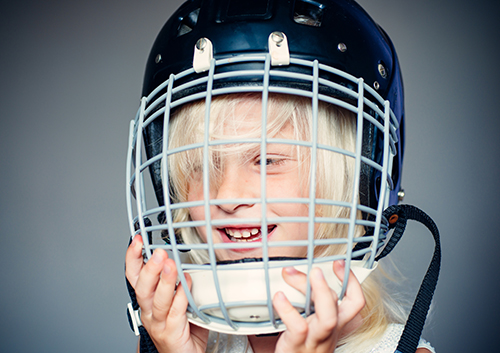
So here’s a new topic for the April calendar: National Facial Protection Month! Take the opportunity this month to review your safety practices while you’re enjoying your favorite activities.

  • Mouthguards

If you have a mouthguard for sports or athletic activities, wear it! In any activity or sport where humans come into contact with solid objects (including other humans) tooth injury is possible. A mouthguard will help protect you from dental injuries caused by falls, physical contact, or other accidents that might happen in your active life. And it’s not just your teeth—mouthguards protect your lips, tongue, and jaw as well.

You can buy mouthguards in stock sizes or shape-to-fit options, or you can have a guard custom made especially for you at our Eagle River office. Custom mouthguards fit perfectly and are designed to make breathing and speaking easy and comfortable. And if you wear braces or have fixed dental work such as a bridge, a custom mouthguard can protect your smile and your appliances. Talk to Drs. Darrin and Greg Gremban about mouthguards for some great advice on how to protect your teeth and mouth.

As long as we’re discussing facial protection, let’s look at some other ways to keep safe as you keep active.

  • Helmets

If there’s a helmet available for your sport, use it! Helmets are especially important for protecting athletes from brain injury and concussion, and they help protect the face and jaw as well.

  • Face Guards

If you’ve experienced a puck speeding toward you, or a defensive tackle hurtling your way, or a fast ball coming in at 90 miles an hour, you know the importance of wearing a face guard. These guards can help protect your eyes, face, teeth, and jaws. Many sports now recommend using face guards—it’s worth checking to see if your sport is one of them.

  • Eye Protection

And let’s not forget eye protection. Whether it’s safety glasses or a visor, protecting your eyes and the bones around them is extremely important. You can even get sports goggles or protective sports glasses with prescription lenses to keep you safe and seeing clearly.

We have the training and experience to help treat and restore injured teeth. But we will be the first to tell you, the very best treatment is prevention!

So here are a few suggestions for your calendar this month:

  • If you haven’t gotten a mouthguard yet, now’s the time. Tooth and mouth injuries occur in sports beyond hockey and football. If you play basketball, ski, skateboard, ride a bike—in fact, almost any sport where you can fall or make contact with a person or object—a mouthguard is a must.
  • If you need to replace an ill-fitting or damaged helmet and face guard, do it before your next game. And do replace a bike helmet if you’ve been in a crash—most likely it won’t be as protective, even if damage isn’t visible.
  • Talk to your eye doctor about protective eyewear if off-the-rack products don’t work for you.
  • If you are a parent or caregiver, make sure your child athlete has the proper facial protection—and uses it.
  • If you are a coach, make sure your athletes have the right protective gear—and wear it.
  • It’s also a great time to commit to using your protective gear every single time you’re active.

But, wait—these reminders are helpful and important, but weren’t we promised something to celebrate this April? Good catch! The great news is, using facial protection for sports and athletic activities gives you rewards you can celebrate all year: fewer injuries, fewer visits to the emergency room, and a beautiful, healthy, intact smile. Suit up!

Back to top